
Resistant Starch in Green Banana Powder: Lab-Tested Content and the AOAC 2022.01 Method
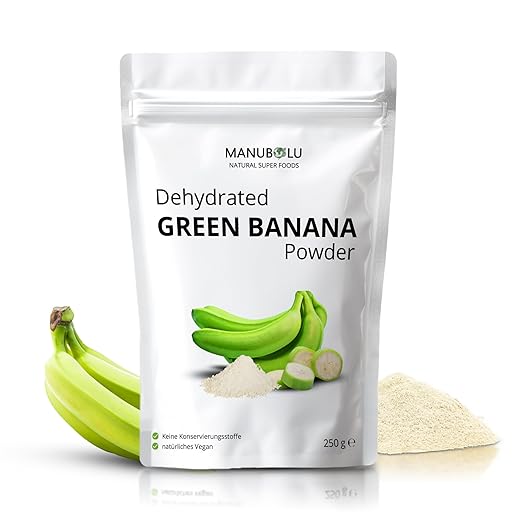
Green banana powder is one of the richest natural sources of resistant starch you can buy. But how much resistant starch it actually contains, and how much dietary fibre, depends heavily on which laboratory method is used to measure it. This article explains the resistant starch and fibre content of green banana powder, why the modern AOAC 2022.01 method matters, and shows the independent lab results for Manubolu green banana powder.
Regulatory note: This article presents publicly available scientific findings and independent laboratory results. It does not make health claims as defined by EU Regulation (EC) No 1924/2006. Manubolu does not claim that green banana powder prevents, treats, or cures any disease.
What Is Resistant Starch?
Resistant starch (RS) is a type of starch that resists digestion in the small intestine and passes to the large intestine, where it is fermented by gut bacteria, acting as a prebiotic. It is classified into four types (RS1–RS4). Green banana flour is a natural source of RS2: starch granules in their native, ungelatinised form.
According to the European Food Safety Authority (EFSA), replacing digestible starches with resistant starch in a meal contributes to a reduction in post-prandial glycaemic responses. This is an EU-authorised health claim under Commission Regulation (EU) No 432/2012, and it may be used only for foods in which digestible starch has been replaced by resistant starch so that the final resistant starch content is at least 14% of total starch.
How Much Resistant Starch Is in Green Banana Powder?
Research published in Food Research International (Tribess et al., 2009) measured resistant starch content in green banana flour between 40% and 58% of total starch, depending on the banana variety and processing conditions. This places green banana flour among the highest natural sources of resistant starch.
For our own product, we do not rely on general literature alone. Manubolu green banana powder (batch DBP-20260314-001) was independently tested by Eurofins in Leipzig, Germany, using the AOAC 2022.01 method. The measured results were:
| Parameter | Result (per 100g) | Method |
|---|---|---|
| Total dietary fibre | 76.5 g | AOAC 2022.01 (accredited) |
| Insoluble dietary fibre | 26.3 g | AOAC 2022.01 (accredited) |
| Soluble dietary fibre (total) | 50.2 g | AOAC 2022.01 (accredited) |
| Resistant starch | 39 g | Spectrophotometry (subcontracted, not accredited) |
The resistant starch figure (39%) sits within the total dietary fibre figure (76.5%), which is consistent with green banana powder being a fibre-dominant, resistant-starch-rich ingredient.
Why the Testing Method Changes the Result
Here is the part most product listings never explain. The same green banana powder can return very different fibre numbers depending on the laboratory method used.
Older enzymatic-gravimetric methods such as AOAC 985.29 and 991.43 (the classic Prosky-type methods) use enzyme and incubation conditions that break down resistant starch and count it as digestible carbohydrate. For most foods that is fine. But for a resistant-starch-rich food like green banana powder, these older methods are effectively blind to the majority of the fibre, and they report a much lower total.
The modern AOAC 2022.01 method (McCleary and McLoughlin, 2023) is a rapid integrated procedure combining enzymatic-gravimetric analysis with liquid chromatography. It uses digestion conditions that mimic the human small intestine and captures the full range of dietary fibre components, including resistant starch, high-molecular-weight soluble and insoluble fibre, and low-molecular-weight soluble dietary fibre. Peer-reviewed guidance on method selection (Journal of AOAC International, 2023) specifically recommends the integrated method for foods that may contain resistant starch.
In short: a low fibre number on a green banana powder often means an outdated test method was used, not that the product is low in fibre. Always check which AOAC method was applied.
Is Green Banana Powder High in Fibre?
Based on the accredited AOAC 2022.01 result of 76.5g total dietary fibre per 100g, Manubolu green banana powder qualifies as a high-fibre food under both major frameworks:
- European Union: the “high fibre” threshold under Regulation (EC) No 1924/2006 is at least 6g of fibre per 100g. Green banana powder at 76.5g/100g is far above it.
- United States (FDA): an “excellent source of fibre” requires at least 20% of the Daily Value (28g) per serving. A 10g serving provides roughly 7.7g of fibre, about 27% of the Daily Value.
Our Lab Reports
We publish our independent laboratory reports for full transparency. You can view and download the reports for green banana powder batch DBP-20260314-001 below:
Common Uses
Comparing options? See What Is the Best Source of Resistant Starch? A Lab-Tested Comparison for how green banana powder stacks up against potato starch, hi-maize, and legumes.
Green banana powder is used as a gluten-free flour alternative in baking, as a natural thickener in food manufacturing, and as a prebiotic dietary fibre supplement. Its neutral, mild flavour makes it easy to add to smoothies, porridge, yoghurt, and baked goods without significantly changing the taste.
View our Green Banana Powder, sourced from farms in southern India, milled from unripe bananas, and independently lab-tested for every batch.
Sources
- McCleary, B.V. & McLoughlin, C. (2023). Determination of Insoluble, Soluble, and Total Dietary Fiber in Foods Using a Rapid Integrated Procedure of Enzymatic-Gravimetric-Liquid Chromatography: First Action 2022.01. Journal of AOAC International, 106(1), 127–145. doi.org/10.1093/jaoacint/qsac098
- McCleary, B.V. et al. (2023). Measurement of Dietary Fiber: Which AOAC Official Method of Analysis to Use. Journal of AOAC International, 106(4), 917. ncbi.nlm.nih.gov
- Tribess, T.B. et al. (2009). Thermal properties and resistant starch content of green banana flour produced at different drying conditions. Food Research International, 42(8), 1022–1025. doi.org/10.1016/j.foodres.2009.04.013
- EFSA Panel on Dietetic Products, Nutrition and Allergies (2011). Scientific Opinion on the substantiation of health claims related to resistant starch and reduction of post-prandial glycaemic responses (ID 681). EFSA Journal, 9(4), 2024. doi.org/10.2903/j.efsa.2011.2024
- Commission Regulation (EU) No 432/2012, List of permitted health claims made on foods. eur-lex.europa.eu
- Manubolu independent laboratory reports, batch DBP-20260314-001: Eurofins Food & Feed Testing Leipzig GmbH (dietary fibre, AOAC 2022.01) and Intertek India Pvt. Ltd. (safety panel). View reports