
What Is the Best Source of Resistant Starch? A Lab-Tested Comparison
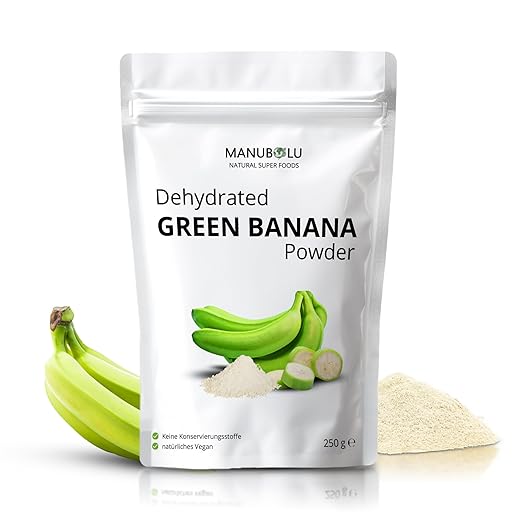
“What is the best resistant starch product?” is one of the most common questions in gut-health nutrition, and the honest answer is: it depends on what you need it for. The highest raw percentage is not always the most useful product. Below is a factual, source-backed comparison of the main resistant starch options, including independent laboratory data for our own green banana powder.
Regulatory note: This article presents publicly available scientific findings and independent laboratory results. It does not make health claims as defined by EU Regulation (EC) No 1924/2006. Manubolu does not claim that any product prevents, treats, or cures any disease.
Quick Comparison of Resistant Starch Sources
Approximate resistant starch (RS) content from published analyses. Values vary by variety, processing, and test method.
| Source | Resistant starch | RS type | Can you cook with it? |
|---|---|---|---|
| Green banana powder (Manubolu, lab-tested) | 39 g / 100 g | RS2 | Yes (baking, smoothies, cooking) |
| Green banana flour (published range) | 40–58% of starch | RS2 | Yes |
| Raw potato starch | ~47–59% of dry matter | RS2 | No (heat destroys RS) |
| Hi-maize (high-amylose corn) | Isolated commercial RS2 | RS2 | Partly (heat-tolerant grades) |
| Cooked & cooled potatoes | ~5–6 g / 100 g | RS3 | Already cooked |
| Beans & legumes (cooked) | ~4–10 g / 100 g | RS1/RS2 | Already cooked |
| Whole green (unripe) bananas | ~10–12 g / 100 g | RS2 | Eaten raw/cooked |
Why the Highest Percentage Is Not Always “Best”
Raw potato starch has one of the highest resistant starch percentages by weight. But there is a catch: its resistant starch is RS2, which is destroyed by heat. Cook it and most of the resistant starch gelatinises into ordinary digestible starch. It also has virtually no other nutrition and cannot be baked into food while keeping its benefit.
Green banana powder is also an RS2 source, but it is far more versatile as a whole-food ingredient: it can be baked, blended, and cooked into recipes, and it delivers substantial total dietary fibre alongside the resistant starch. That combination of usability plus fibre is why green banana flour is often the most practical choice for everyday use rather than a raw starch you can only stir into cold water.
How to Judge a Resistant Starch Product
- Look for a lab-tested figure, not a theoretical one. Many products cite supplier or estimated values. A credible product references an accredited laboratory method.
- Check the test method. Resistant starch should be measured by AOAC 2002.02, and total dietary fibre by the modern AOAC 2022.01 method. Older fibre methods under-report resistant-starch-rich foods.
- Prefer whole-food sources if you want fibre and nutrients, not just isolated starch.
- Consider usability. A product you can actually cook and bake with fits into daily life better than one that must be eaten raw.
Where Manubolu Green Banana Powder Stands
We publish independent laboratory reports rather than relying on general literature. For batch DBP-20260314-001, tested by Eurofins in Germany using the AOAC 2022.01 method:
- Total dietary fibre: 76.5 g per 100 g (accredited method)
- Resistant starch: 39 g per 100 g
- Also independently tested for heavy metals, pesticides, and aflatoxins (Intertek)
Honest note: green banana powder is not the single highest resistant starch material in existence. Isolated or enzymatically-concentrated products can measure higher on paper. What green banana powder offers is a strong, lab-verified resistant starch content combined with high total fibre, whole-food versatility, and published accredited testing.
View our Green Banana Powder, sourced from unripe bananas in southern India, lab-tested every batch.
Sources
- Tribess, T.B. et al. (2009). Resistant starch content of green banana flour. Food Research International, 42(8), 1022–1025. doi.org
- Pacheco, M.T. et al. (2025). Modification of green banana and maize starches. LWT / Food Science. sciencedirect.com
- Robertson, T.M. et al. (2018), cited in raw potato resistant starch reviews (~47–59% RS of dry matter). ncbi.nlm.nih.gov
- Resistant starch content of foods (beans/legumes ~4–10 g/100 g; cooked-and-cooled potato ~5–6 g/100 g). Healthline review citing PMC10819196. healthline.com
- McCleary, B.V. & McLoughlin, C. (2023). Total Dietary Fiber, First Action 2022.01. Journal of AOAC International, 106(1), 127–145. doi.org
- Manubolu independent laboratory reports, batch DBP-20260314-001 (Eurofins, Intertek). View reports