
Green Banana Powder: Resistant Starch and Its Role in Nutrition
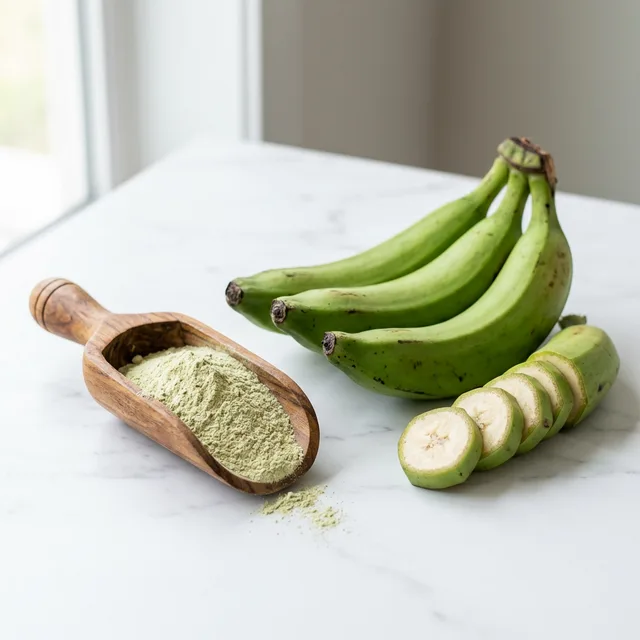
Green banana powder, produced by drying and milling unripe bananas (Musa paradisiaca), has attracted growing interest as a natural food ingredient, largely because of its high content of resistant starch.
Regulatory note: This article presents publicly available scientific findings. It does not make health claims as defined by EU Regulation (EC) No 1924/2006. Manubolu does not claim that green banana powder prevents, treats, or cures any disease.
What Is Resistant Starch?
Resistant starch (RS) is a type of starch that resists digestion in the small intestine and passes to the large intestine, where it is fermented by gut bacteria. It is classified into four types (RS1–RS4), with green banana flour being a natural source of RS2, starch granules in their native, ungelatinised form.
According to the European Food Safety Authority (EFSA), the replacement of digestible starches with resistant starch in a meal contributes to a reduction in post-prandial glycaemic responses. This is an EU-authorised health claim under Regulation (EU) No 432/2012, applicable when the food provides at least 14% of total starch as resistant starch.
Resistant Starch Content in Green Banana Flour
Research published in Food Research International (Tribess et al., 2009) measured RS content in green banana flour between 40% and 58% of total starch, depending on the banana variety and processing conditions. This places green banana flour among the highest natural sources of resistant starch.
Documented Nutritional Composition
Per 100g of typical green banana powder (approximate values from published analyses):
- Carbohydrates: 76–82g (of which resistant starch: 30–45g)
- Dietary fibre: 6–14g
- Protein: 3–5g
- Fat: < 1g
- Potassium: approximately 1,200–1,500mg
Common Uses
Green banana powder is used as a gluten-free flour alternative in baking, as a thickener in food manufacturing, and as a dietary fibre supplement. Its neutral flavour makes it suitable for addition to smoothies, porridge, and baked goods without significantly altering taste.
View our Green Banana Powder, sourced from farms in southern India, milled from unripe Nendran bananas.
See our lab results: For the independently tested resistant starch and fibre content of our green banana powder (76.5% total dietary fibre, 39% resistant starch by the AOAC 2022.01 method), read Resistant Starch in Green Banana Powder: Lab-Tested Content and the AOAC 2022.01 Method.
Sources
- Tribess, T.B. et al. (2009). Thermal properties and resistant starch content of green banana flour produced at different drying conditions. Food Research International, 42(8), 1022–1025. doi.org
- EFSA Panel on Dietetic Products (2011). Scientific Opinion on the substantiation of health claims related to resistant starch. EFSA Journal, 9(4), 2024. efsa.europa.eu
- Commission Regulation (EU) No 432/2012, List of permitted health claims. eur-lex.europa.eu