
Freeze-Dried vs. Hot-Air Green Banana Powder: A Comparative Guide
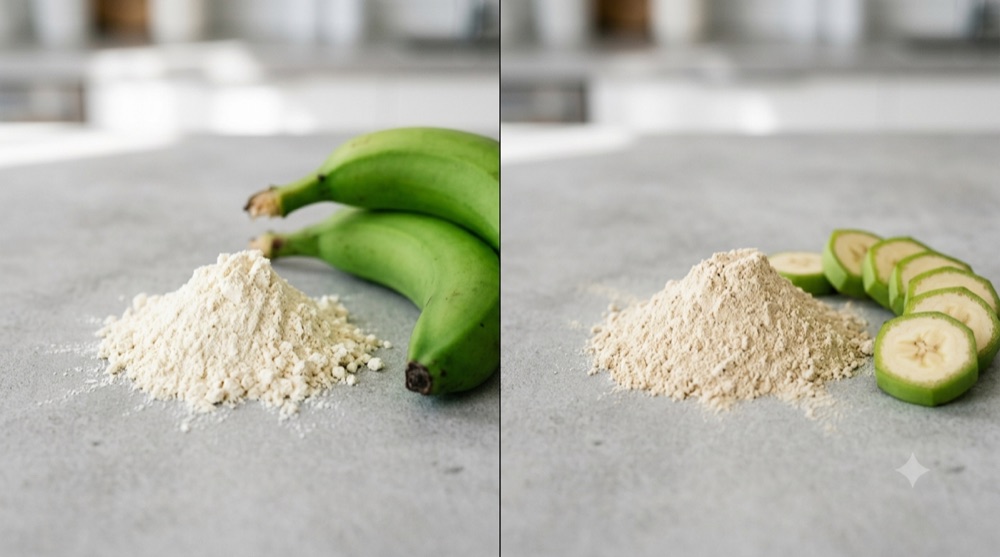
Green banana powder is made by drying and milling unripe bananas (Musa spp.) while their starch is still in its native, undigested form. But the way the water is removed during drying changes the final powder in meaningful ways. Two methods dominate: freeze-drying and hot-air drying. Neither is simply "better", they produce different products suited to different uses.
This guide walks through how each method works, what it does to the powder's nutrition and texture, and how to choose the right one for your needs.
Regulatory note: This article presents publicly available scientific findings. It does not make health claims as defined by EU Regulation (EC) No 1924/2006. Manubolu does not claim that green banana powder prevents, treats, or cures any disease.
Why the Raw Material Matters
An unripe green banana is roughly three-quarters water, and most of its dry weight is starch. In the green state, a large share of that starch is resistant starch (RS2), tightly packed, semi-crystalline granules that resist digestion in the small intestine and are fermented by gut bacteria in the colon. The green fruit is also rich in potassium, magnesium, Vitamin C, and plant polyphenols.
The challenge of drying is to stabilise this delicate matrix without converting the resistant starch into rapidly digestible starch or degrading the heat-sensitive compounds. This is exactly where the two methods diverge.
How the Two Methods Work
Freeze-Drying
Water is first frozen into ice, then removed by sublimation under vacuum, ice turns straight into vapour, never passing through a liquid stage.
Sub-zero throughout the main drying phase.
Cellular scaffolding stays intact, leaving a porous, sponge-like powder.
Long, typically a full day or more of continuous processing.
Hot-Air Drying
Warm air (around 50–80°C) passes over the banana slices, evaporating moisture as it migrates from the inside to the surface.
Warm air applied continuously through the dry.
Cells shrink and the surface densifies ("case-hardening"), giving a compact powder.
Faster, usually well under a day, suited to high throughput.
That single difference, sublimation versus evaporation, is the root of every other distinction below.
Nutrition: What Each Method Preserves
Because freeze-drying never exposes the banana to the heat-and-moisture combination that triggers starch gelatinisation, it tends to preserve the most resistant starch and the most heat-sensitive nutrients. Low-temperature hot-air drying still keeps a substantial amount, but retention falls as the drying temperature climbs.
| Parameter | Freeze-Dried | Hot-Air (low temp) |
|---|---|---|
| Resistant starch | Highest retention | Good; declines at higher temperatures |
| Vitamin C retention | High | Lower (heat-sensitive) |
| Polyphenols / antioxidants | Maximum recovery | Reduced by thermal exposure |
| Dietary fibre | Well preserved | Slightly lower |
| Mineral bioaccessibility | High (porous matrix) | Good; denser matrix |
The minerals themselves are not lost to heat, potassium and magnesium do not evaporate, but the porous structure of freeze-dried powder makes them easier to extract and absorb in water.
Nutritional & Molecular Data
The chart below compares the two methods across three groups. Select a category to switch the view.
Values shown are drawn from independent academic studies of green banana flour and are not based on Manubolu product testing. Actual figures vary with banana variety and exact processing conditions.
Texture, Colour, and Behaviour in Recipes
The physical structure left behind by each process changes how the powder looks and behaves:
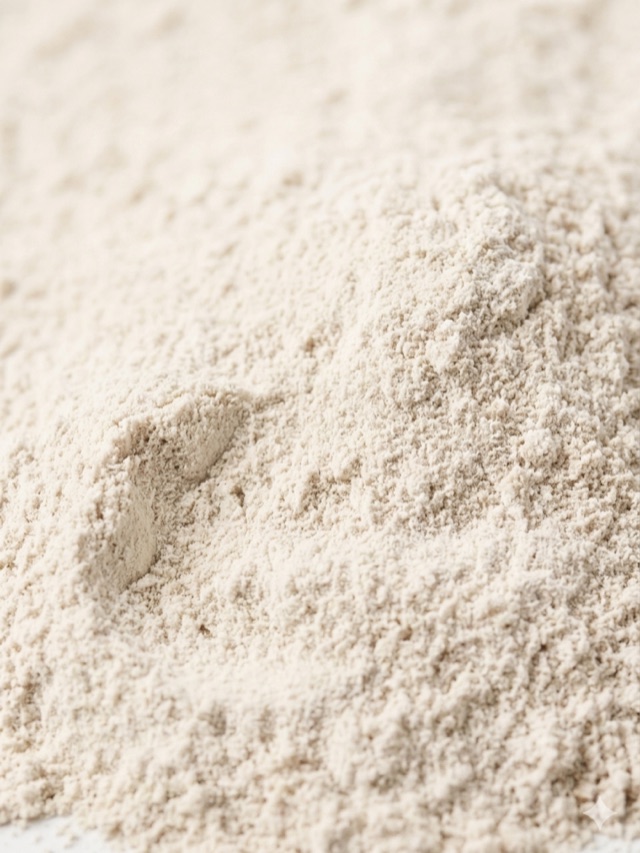
- Hydration: The open, porous structure of freeze-dried powder absorbs water and oil readily, which suits beverages and instant blends. Hot-air powder is denser and hydrates more slowly.
- Colour: Freeze-drying halts browning, so the powder stays pale, cream to off-white. Hot-air drying can trigger gentle browning, producing a warmer tone.
- Flavour: Freeze-dried powder keeps a clean, neutral profile close to the fresh fruit. Hot-air drying develops mild roasted notes that some bakers actively prefer.
- Flowability and packing: Hot-air powder is denser, so it flows predictably and ships compactly. Freeze-dried powder is lighter and fluffier.
Choosing the Right Powder
The decision comes down to how the powder will be used.
Choose Freeze-Dried When
The powder is consumed raw or cold, smoothies, shakes, cold blends, and applications where maximum resistant starch, colour, and a clean flavour matter most.
Choose Hot-Air When
The powder will be baked or cooked anyway, breads, biscuits, pancakes, and pasta, where a dense, even-flowing powder and a warmer flavour are an advantage.
In short, freeze-dried green banana powder is the choice when you want to deliver the fruit as close to its raw state as possible. Hot-air dried powder is the practical, robust option for baked and cooked foods, where heat is part of the recipe regardless.
The bottom line: Both methods turn surplus green bananas into a shelf-stable, fibre-rich ingredient and help reduce post-harvest food waste. The right choice is the one that matches how the powder will finally be used.
Curious about our green banana range? View our Green Banana Powder or explore B2B options.
Sources
- Tribess, T.B. et al. (2009). Thermal properties and resistant starch content of green banana flour produced at different drying conditions. Food Research International, 42(8), 1022–1025. doi.org
- Ratti, C. (2001). Hot air and freeze-drying of high-value foods: a review. Journal of Food Engineering, 49(4), 311–319. doi.org
- Quality attributes of the developed banana flour: Effects of drying methods (2023). PMC. ncbi.nlm.nih.gov
- Influence of convection drying with hot air on the physicochemical and phytochemical properties of green banana flour (2023). Frontiers in Sustainable Food Systems. frontiersin.org