
What Is Freeze-Drying? The Science Behind Preserving Nutrients
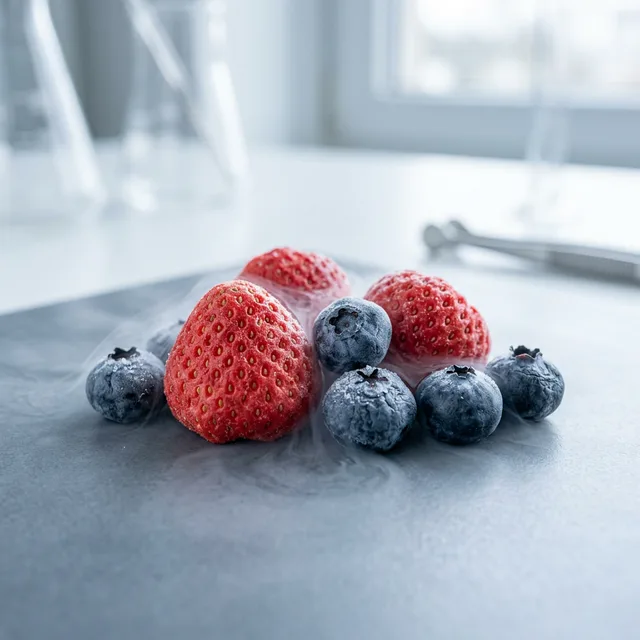
Freeze-drying, technically known as lyophilisation, is a low-temperature dehydration process that removes water from food by sublimation. Unlike conventional drying with heat, freeze-drying preserves the original structure, colour, and nutritional profile of the raw material to a remarkable degree.
How the Process Works
The freeze-drying process consists of three distinct phases:
- Freezing: The raw food is rapidly frozen to temperatures between −30°C and −50°C. This converts the water content into solid ice crystals.
- Primary Drying (Sublimation): The frozen food is placed in a vacuum chamber. Under reduced pressure, the ice crystals sublimate, they transition directly from solid to vapour without passing through a liquid state. This is the core of the process and typically takes 12–24 hours.
- Secondary Drying (Desorption): Remaining bound moisture is removed by slightly raising the temperature, reducing the final water content to approximately 1–4%.
The result is a lightweight, shelf-stable product that retains its original shape, taste, and, critically, its nutritional composition.
Why Nutrients Are Preserved
Heat is the primary enemy of heat-sensitive vitamins such as Vitamin C and certain B vitamins. Because freeze-drying operates at sub-zero temperatures, the thermal degradation that occurs in conventional hot-air drying or spray drying is largely avoided.
Research published in the Journal of Food Engineering has documented that freeze-dried fruits retain between 90% and 97% of their original vitamin content, compared to 60–75% for hot-air dried equivalents (Ratti, 2001; Marques & Freire, 2005).
Shelf Life and Practicality
With moisture content below 4%, freeze-dried products are resistant to microbial growth and enzymatic degradation. When stored in airtight packaging away from moisture and light, freeze-dried foods can maintain their quality for 12–25 years, depending on the product and packaging conditions.
This makes freeze-drying particularly valuable for:
- Preserving seasonal fruits year-round
- Reducing transport weight (up to 90% lighter than fresh)
- Creating shelf-stable ingredients for food manufacturers
- Emergency food supplies and outdoor nutrition
Freeze-Drying at Manubolu
At Manubolu, we use freeze-drying for our mango slices, banana slices, pineapple slices, and fruit powders. The raw fruit is harvested at peak ripeness from partner farms in India and processed within 24 hours to lock in nutrients and flavour.
Interested in our freeze-dried range? View our products or explore B2B options.
Sources
- Ratti, C. (2001). Hot air and freeze-drying of high-value foods: a review. Journal of Food Engineering, 49(4), 311–319. doi.org
- Marques, L.G. & Freire, J.T. (2005). Analysis of freeze-drying of tropical fruits. Drying Technology, 23(6), 1357–1365.
- European Food Safety Authority (EFSA). Food preservation and nutrient retention. efsa.europa.eu