
Beetroot Powder and Dietary Nitrates: The Science Behind the Pre-Workout Effect
Published 26 May 2026 | By MANUBOLU Natural Superfoods | 6 min read
This article reviews peer-reviewed scientific literature on dietary nitrates. It is not health or nutritional advice. The findings described relate to research cited below and are not health claims approved by EFSA under Regulation (EC) No 1924/2006.
Beetroot is one of the richest vegetable sources of dietary nitrates, and a growing body of peer-reviewed research has examined how nitrate intake may influence physiological processes relevant to physical activity. This post summarises what nitrates are, how the conversion pathway works in the body, and what published studies have reported about timing and dosage protocols used in sports science research.
What Are Dietary Nitrates?
Dietary nitrates (NO3-) are naturally occurring compounds found in a range of vegetables. Beetroot is one of the richest sources, containing roughly 250–300 mg of nitrate per 100 g of fresh weight. When you consume beetroot powder, those nitrates do not act on their own. The conversion process is what makes them useful.
The pathway works in three steps:
- Nitrate (NO3-) is absorbed into the bloodstream after digestion.
- Bacteria in saliva reduce nitrate to nitrite (NO2-).
- Nitrite is further reduced under low-oxygen conditions to nitric oxide (NO) in the blood and tissues.
This last step is the one that matters for exercise. Nitric oxide is a potent vasodilator. It signals the smooth muscle lining of blood vessels to relax, causing them to widen. The result is increased blood flow and more efficient delivery of oxygen and nutrients to working muscles.
According to research reviewed by the Gatorade Sports Science Institute, nitric oxide is described as relaxing and expanding blood vessels, which in study conditions was associated with increased blood flow and oxygen delivery to muscles during exercise. These are mechanistic observations from cited research, not claims made about this or any food product.
Why Beetroot? Why Not a Supplement?
Synthetic nitrate salts exist, but research consistently shows that nitrate from whole food sources performs better. The Gatorade Sports Science Institute notes that consuming nitrate naturally via vegetable intake appears to be more effective than nitrate salts. This is likely because beetroot contains additional bioactive compounds, including betalains (the red pigment with antioxidant properties) and polyphenols, which may support the nitrate pathway independently.
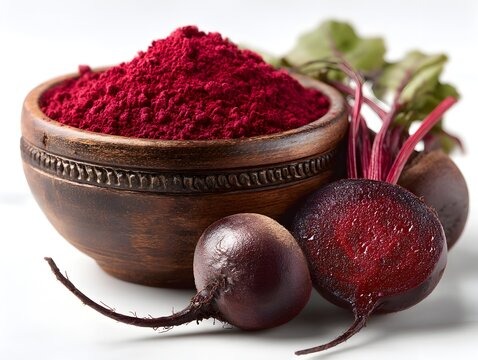
Beetroot powder is a concentrated form of the whole vegetable. One teaspoon of quality beetroot powder is broadly equivalent to one whole beet. For athletes and fitness enthusiasts who need a consistent, measurable dose without preparing fresh juice, powder is a practical and shelf-stable option.
What Published Research Has Reported
Several peer-reviewed studies have examined dietary nitrate supplementation and physical performance outcomes. The findings below are summaries of those specific studies and do not represent authorized health claims under EU Regulation (EC) No 1924/2006.
- In a 2009 study (Bailey et al., Journal of Applied Physiology), recreational cyclists who consumed beetroot juice for six days showed improved time to exhaustion at higher intensity levels compared to placebo. The research authors described the magnitude of the effect as notable.
- A study by Lansley et al. (2018) reported that participants consumed less oxygen when walking uphill after a beetroot supplement compared to placebo, and showed faster recovery times.
- Peeling et al. (2015, International Journal of Sport Nutrition) reported an average 1.7% improvement in 500 m kayak time trial performance in national-level athletes following beetroot juice supplementation vs. placebo.
- A 2024 review in Frontiers in Nutrition examined multiple studies and reported associations between beetroot supplementation and muscle contractility and endurance outcomes across different athlete populations.
The mechanism proposed across these studies is that dietary nitrate may reduce the oxygen cost of exercise through the nitrate-nitrite-nitric oxide pathway. These are findings from controlled research settings. Individual outcomes will vary.
Protocols Used in Sports Research
Published studies on dietary nitrate and exercise have used a range of dosing and timing protocols. The table below summarises what has been reported in the cited literature. This is not nutritional advice or a recommended intake level for any food product.
| Variable | As reported in cited research |
|---|---|
| Timing | 60 to 90 minutes before training or competition |
| Acute dose | 300 to 600 mg dietary nitrate per session |
| Loading protocol | 3 to 7 days of daily intake to maximise plasma nitrite levels |
| Best suited for | Endurance training, HIIT, strength circuits, team sports |
| How to take it | Mixed in water, added to a smoothie, or stirred into yogurt |
The 60 to 90 minute pre-exercise window reflects the observed peak in plasma nitrite levels as reported in pharmacokinetic studies. The Gatorade Sports Science Institute notes in their literature review that the final dose should be ingested at least 90 minutes prior to exercise. For the 3 to 7 day loading protocol, research has reported that plasma nitrite accumulates with repeated intake, and several studies found larger effect sizes under multi-day protocols compared to single acute doses.
The above reflects protocols used in published research. It is not a dosage recommendation. Consult a qualified nutrition professional before making changes to your diet or supplementation.
What Beetroot Powder Will Not Do
It is worth being clear on the limits of the evidence. Most of the performance data comes from endurance and submaximal exercise. The benefits are less pronounced, though still present, in shorter high-intensity efforts and resistance training. Elite athletes at very high training states also tend to see smaller gains compared to recreational athletes, likely because their cardiovascular systems are already highly efficient.
Beetroot powder is not a stimulant. It does not contain caffeine or any compound that acts on the central nervous system. The effect is physiological and gradual, not the immediate alertness associated with caffeine-based pre-workout products.
About Manubolu Beetroot Powder
Manubolu beetroot powder is produced from whole beetroot, dried at low temperatures and milled to a fine powder. It contains no additives, fillers, or preservatives. Each batch is independently lab tested for composition, contaminants, and quality. Full batch reports are available to download.
The product is a food ingredient. No health or performance claims are made for this product under EU Regulation (EC) No 1924/2006.
This article is for informational purposes only. No health claims are made for any Manubolu product. The research findings referenced have not been individually evaluated or authorised by EFSA under Regulation (EC) No 1924/2006.
References
- Bailey, S.J. et al. (2009). Dietary nitrate supplementation reduces the O2 cost of low-intensity exercise and enhances tolerance to high-intensity exercise in humans. Journal of Applied Physiology, 107(4), 1144–1155.
- Lansley, K.E. et al. (2018). Beetroot juice supplementation reduces the oxygen cost of walking and running. PubMed, 29546639.
- Peeling, P. et al. (2015). Beetroot juice improves on-water 500 m kayak ergometer performance. International Journal of Sport Nutrition and Exercise Metabolism, 25(3), 278–284.
- Gatorade Sports Science Institute (2024). Dietary nitrate and exercise performance: new strings to the beetroot bow. gssiweb.org.
- Frontiers in Nutrition (2024). Beetroot juice supplementation and exercise performance: is there more to the story than just nitrate? doi: 10.3389/fnut.2024.1347242.
- Cleveland Clinic (2023). Can Beetroot Powder Improve Athletic Performance? health.clevelandclinic.org.